
Konrad Marshall’s new book Run For Your Life appeals to me in various ways.
His story begins on New Year’s Day, 2024, with him vowing to run at least 2km daily through the coming year, “no days off, no excuses”.
That was his proposed remedy for being 45 years old, 193cm tall, 117kg, and technically obese.
Marshall, a sportswriter with The Age in Melbourne, grew up with Little Athletics and Aussie Rules. His Dad ran Melbourne’s Big M Marathon in 1983.
In his 20s, while working in the United States, Konrad joined Hash House Harriers, ran road and trail events with the Adirondack Runners and completed the New York Marathon.
But by Christmas 2023, exercising comprised throwing hoops with his 11-year-old son and a bit of jogging, surfing and lifting weights. Through the lens of an unlikely health guru, the US humourist David Sedaris, he had become a slob. This home truth brought on a “fit or fat” epiphany and his plan to spend the coming year interviewing a possie of purposeful fellow runners.
I love the breadth of resulting stories. His journal of 1999km in 366 days is a compendium of fitness lore — physical and mental. It’s an almanac, like broadsheet newspapers used to be, with crannies of crapulent confession and treasures of trivia.
For example, you can share nearly every pit stop of his run through Paris on the last night of the 2024 Games, which he had for The Age and The Sydney Morning Herald. He spent five hours among 20,000 participants in the Marathon Pour Tous, over the official course:
“Not for nothing has this route been dubbed the most brutal course in Olympic Marathon history . . . around 33km, the dreaded wall has well and truly been hit by all. The desolation is abundant. I see a spectator holding a sign that says, `pain is just a French word for bread’ a decent joke but I’m in no laughing mood.”
The treasures, for me at least, include his meeting with an old workmate from The Indiana Star after a boil-over in men’s 1500m final at Paris. The result shocked all the pundits except The Indiana Star’s man, who told Konrad he had followed the American winner, Cole Hocker, 23, since his college days. He had been so sure of Hocker’s gold medal that he wrote a victorious feature story before the race began. The beaten favourite, Norwegian superstar Jakob Ingebrigtsen, faded in the straight. Konrad heard Ingebrigtsen asked if he rued his all-or-nothing tactics, and the Norwegian’s taciturn reply, “No and Yes” which he clarified later — “that wasn’t the plan at all, I ruined it for myself by going way too hard.”
The art of knowing what’s too hard or too easy, too-long or too-short, too-fast or too-slow comes up often in Konrad’s dozens of interviews. His subjects include Australian of the Year Grace Tame, Paris Games 1500m silver medallist Jessica Hull, mountain runner Nicole Paton, world triathlon champion Emma Carney, retired tennis star Jelena Dokic, Indigenous Marathon Project pioneer Charlie Maher and three-times Olympic 800m contender Peter Bol.
Konrad joined Bol on the track at Collingwood one Saturday morning for his weekly all-comers’ 10km training session. Bol says he likes connecting with the real world, making running accessible through his YouTube channel. “It’s hard to get the motivation to run every day,’’ he says. “But with other people it’s fun, and that’s when the training really is great. Four min 40 sec per kilometre is the pace we generally run, but if you can’t do that pace it’s fine.”
Konrad reaches New Year’s Day, 2024, with a string of rewards — being 10kg lighter, sleeping better, having brought asthma, blood pressure and cholesterol under control, adapting to a lower intake of salt, sugar and alcohol and consuming much more water, protein and vegetables. He’s still running too. As for his non-stop feat, he concludes:
“I have gone from viscerally hating running to somewhat hating running, to sometimes hating running, to relying on the routine of running but also still almost never (perhaps five times this year at most) truly loving running . . . it helps me solve problems and regulate emotions and face hurdles. It helps me feel strong and capable and worthy.”
Three months later, his final subject is 82-year-old Derek Clayton, a legendary Australian marathoner. Clayton says he had never run for pleasure, community connection or mindfulness. He tells Konrad: “I was never in it for fun. Never . . . For me, it was all about achievement, I was pushing the boundaries, doing a kind of human experiment to see how much the body could stand.” His 2hr 8min 33.5sec world marathon record set at Fukuoka, Japan, in 1969, stood for 12 years until Rob De Castella broke it. Konrad meets him in Beaumaris, coincidentally midway between Frankston and Melbourne CBD on the old Big M Marathon route. Derek has an artificial right knee, an enlarged heart, niggly back and cannot run any more, but still joins a bunch of cyclists twice a week on a 50km ride to Frankston and back. “I’m very satisfied,” he says. “My advice to my kids has always been to give life your best shot — put everything into it while you can . . . the aim of all that running [I did] isn’t longevity . . . I did it to enjoy my life, because we’re here for a short time and a good time. That’s the choice we make when we run.”
Run For Your Life, by Konrad Marshall, Hardie Grant Books, Melbourne, 2026, rrp $36.99
.’
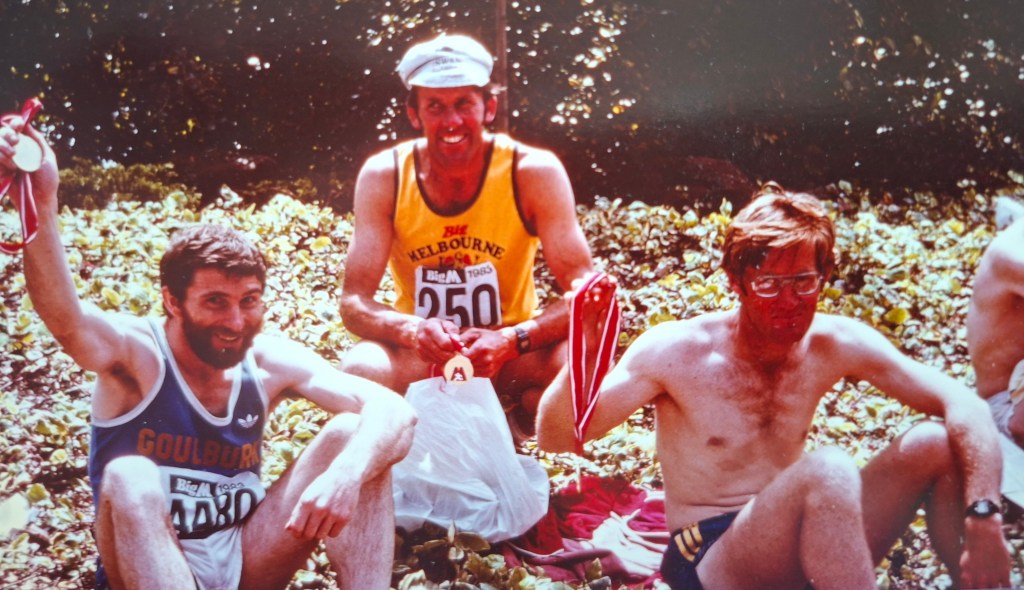
Our Goulburn Distance Runners trio after the 1983 Melbourne Big M Marathon: me, left, Mike Crisp and Peter Mowle. Konrad Marshall’s Dad ran it too that year.


Leave a Reply